Welcome to our 10 Best 5 Axis CNC Router Machines – 2026 Buyer’s Guide! When precision is not negotiable and complexity is the norm, traditional machining processes often run into a brick wall. You are probably all too familiar with this situation if you are a professional working within the realm of high-stakes manufacturing. The line between a “good” part and a “perfect” part is often defined by the capabilities of your machinery. This is where 5-axis CNC routers come in and change the face of modern manufacturing.
Unlike their 3-axis counterparts, which only offer linear movement along the X, Y, and Z axes, 5-axis routers offer two additional axes of rotation, labeled “A” and “B” or “C.” This allows the cutting tool to reach the part from any angle. It is akin to attempting to sculpt a statue with your hands tied behind your back versus having your hands free to create whatever your imagination will allow. This is the fundamental difference between a 3-axis and a 5-axis CNC router.
Having this type of unimpeded movement is a boon for industries requiring complex and intricate part creation and assembly. For the aerospace industry, this means creating complex turbine blades out of a single block of titanium without the need for multiple machine setups. For the automotive world, this equates to rapid prototyping of aerodynamic molds for cars. Even for woodworking and high-end furniture design, this technology allows creatives to bring their visions to life with complex curves and shapes previously not thought possible or cost-effective.
The advantages of these routers go far beyond simply “doing more.” With the ability to machine five sides of a part simultaneously, these routers can cut production time and human error associated with re-fixturing a part down to a fraction of the time and cost of a traditional 3-axis machine.
However, moving into 5-axis machining is a large investment, and with all the options that are now available, finding the best balance of power, precision, and price is of the utmost importance. Whether you’re looking to upgrade your current capabilities or looking to get into advanced manufacturing for the first time, the first step towards unlocking your shop’s true potential is finding the right equipment for the job. In this guide, we’ll cut through all the noise and take a closer look at the 10 best 5-axis CNC routers that can be found today.
10 Best 5 Axis CNC Router Machines – 2026 Buyer’s Guide: Key Features to Consider
When investing in a 5-axis CNC router, this is one of the biggest decisions that can be made for your shop, potentially defining what you can accomplish in the future. However, what is best for an aerospace facility is not necessarily best for a cabinetry shop, and what is best for one shop is not necessarily best for another. To make sure that your investment is one that pays off, there are several key features that need to be considered, all of which play a critical role in the overall performance, workflow, and reliability of the equipment.
1. Rigidity and Build Quality
When it comes to precision, the foundation of accuracy is stability, and this is true of 5-axis machining more than any other type of CNC machining due to the angles at which the router is approaching the workpiece. As such, the 5-axis CNC router needs to be built on a strong foundation, such as a heavy-duty steel frame or cast iron base, that is designed to handle the vibrations that come from high-speed cutting. If the 5-axis CNC router is not stable, you’ll be able to see it in the finish of the finished part, as well as take precise measurements of the finished part, both of which are unacceptable in precision machining environments.
2. Spindle Power and Speed
The spindle is the “heart” of a router, and its specifications must meet your material requirements.
Aerospace and Automotive: When cutting aluminum, composites, and titanium, you’ll need a spindle with the torque to provide power at lower spindle speeds.
Woodworking and Foam: When cutting softer materials, you’ll need a spindle that can achieve high spindle speeds, often above 24,000 RPM, to provide the smooth finishes and cutting speeds required.
The interface is also important, such as the HSK-63F or ISO 30 interface. This is important because you’ll need to ensure that the tool is concentric to the spindle, and this is critical to the longevity of the tool.
3. Work Envelope (Travel Size)
The most common regret that buyers have is that they purchased a machine that is too small. The work envelope is the physical dimensions that define the largest part that can be machined. In 5-axis machines, you’ll also need to factor in the extra space required to accommodate the rotary head’s ability to tilt and swivel the cutting tool. The Z-axis travel, although seemingly large, can become restrictive when you factor in the tool’s length and the clearance required to rotate 90 degrees.
4. Controller and Software Compatibility
The “brain” of the CNC is just as important as the physical machine itself, and 5-axis cutting requires advanced calculations to ensure that the five axes are cutting in tandem with each other. You’ll need a controller that can handle the calculations quickly to avoid “data starving,” where the machine will stutter because it is waiting for instructions to be sent to the spindle.
Equally important, however, is software compatibility. Will this machine work seamlessly with your chosen CAD/CAM software (e.g., Mastercam, Fusion 360, Powermill)? A machine that forces a lengthy and potentially frustrating process of developing custom post-processors may not be the best choice.
5. Accuracy and Repeatability
If you are in an industry that requires micron-sized precision, check the specifications for positional accuracy and repeatability. What this means is exactly how close the machine will get to the exact spot, and how consistently it will hit that exact spot. High-end machines may even feature linear scales in all three axes, which provide feedback to the machine controller in real-time, correcting for any error that may be introduced by thermal expansion.
6. Ease of Use and Calibration
While a machine may be feature-rich, it should never be impossible to use. Features like Tool Center Point Control allow the machine to “know” exactly where the tool tip is, regardless of the pivot angle, greatly simplifying the programming process. Similarly, automated calibration systems are a necessity in 5-axis machines, which are prone to a small degree of “drift” due to temperature changes, crashes, etc. An integrated probing system that can quickly recalibrate the kinematics in a matter of minutes, rather than hours, keeps your spindle running and your parts accurate.
Top 10 5-Axis CNC Router Machines: A Comprehensive Review
1. Biesse Rover A FT
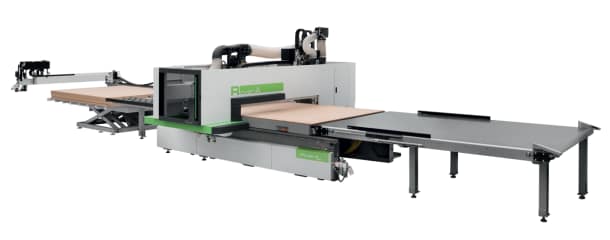
When it comes to precision and volume in woodworking and other composite materials, there are few machines that stand out quite like the Biesse Rover A FT. This Italian machine is designed for shops that don’t just require 5-axis capability, but also speed, reliability, and automation potential. It is a machine designed for a production shop environment, where every second of spindle time counts.
The Rover A FT has a heavy-duty stress-relieved steel gantry that helps in the absorption of vibrations while ensuring precision during high-speed machining. Perhaps one of the most notable features of this machine is that it has a powerful 5-axis operating head that ensures excellent performance in a variety of tasks, from panel processing to solid wood machining.
Spindle: This machine usually has a powerful HSD electrospindle that provides high power, ranging from 13 kW to 17 kW. This ensures that the machine can handle even the toughest cuts in hardwoods and aluminum while also ensuring that it can provide high RPMs necessary for finer cuts.
Work Table: This machine also has a full-grid aluminum worktable that provides optimal benefits for nesting-based manufacturing. This makes it ideal for cutting large quantities of materials, especially plywood, MDF, etc.
Controller and Software: This machine has proprietary bSolid CAD/CAM software that provides surprising ease of use for a powerful 5-axis router. This makes it ideal for complex 5-axis machining while also ensuring that users can avoid costly errors.
Automation: This machine is also designed for automated production and can be used in conjunction with loading and unloading systems. This makes it ideal for lights-out production.
What Makes It Stand Out?
Perhaps the biggest reason why the Rover A FT stands out from other machines in the same class is that it combines robust 5-axis features with a flat table and optimal nesting benefits. This makes it ideal for machining complex features in large panels in a single setup. This eliminates the need for secondary machining, making it ideal for cabinet making, furniture making, and even architectural millwork. This feature makes it ideal for production environments where tight tolerances must be maintained even during high-speed machining.
Pros and Cons
Pros:
Outstanding for Nesting: The flat table configuration with the powerful vacuum hold-down system is optimized for the efficient machining of full sheets of material.
High-Performance Spindle: Offers an excellent balance of power and speed for machining a variety of materials.
Robust and Reliable Design: The heavy-duty machine is built to last with minimal vibration for increased accuracy.
Easy-to-use Software: The bSolid software suite greatly reduces the complexity of the 5-axis programming process for the machine.
Cons:
Not as Good for Block Work: Although the machine is certainly capable of machining large blocks of material, the flat table is not as well-suited for machining very tall or awkwardly shaped blocks of material as the pod-and-rail system would be.
High Investment Cost: As with other high-end industrial equipment, the price of the machine reflects the power and capabilities of the machine, which is certainly a significant investment for many shops.
Ideal Use Cases
The Biesse Rover A FT is the perfect machine for high-production machining environments.
High-End Cabinetry: The machine is well-suited for the machining of custom cabinetry with complex joinery, curved shapes, or angled drillings without the need for multiple machine configurations.
Architectural Millwork: The machine is excellent for the machining of custom wall panels, complex moldings, or other architectural components that demand 5-axis machining capabilities.
Plastics and Composite Panels: The machine is well-suited for machining complex materials for use in the marine or transportation industries.
2. DMS 5-Axis Enclosed Router (Diversified Machine Systems)
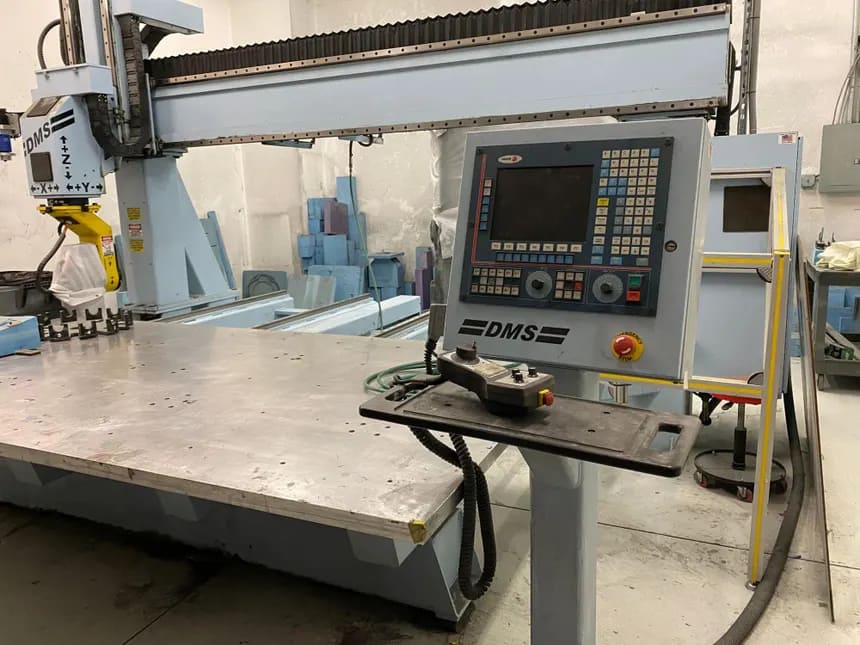
For manufacturers looking to enter the realm of composite part machining and heavy-duty trimming, Diversified Machine Systems (DMS) is a company with which manufacturers should be familiar. Diversified Machine Systems is based in the USA and is known for building heavy-duty, 5-axis machines tailored to each manufacturer’s needs. Their line of Enclosed 5-Axis Routers is designed to combat the mess and safety concerns associated with composite part machining while maintaining precision levels necessary for the aerospace industry.
Key Features & Specifications
The DMS Enclosed 5-Axis Router is a heavy-duty machine designed with safety and containment in mind. Unlike other 5-axis routers, this machine features an enclosed workspace, which is necessary for containing dust, chips, and noise—especially necessary for working with composite materials such as carbon or fiberglass.
Structure: The DMS Enclosed 5-Axis Router features a moving bridge style with a stationary table, ensuring stability for heavy workpieces. The frame is constructed with stress-relieved steel to reduce vibration during heavy cuts.
Controller: DMS machines are generally equipped with Fagor 8065 or 8070 controllers. Fagor is a well-known controller for heavy-duty machines, offering advanced “look ahead” capabilities and smooth motion control necessary for 5-axis machines.
Spindle Options: Diversified Machine Systems offers many different spindle options for their machines, typically HSD or Colombo, ranging from 12 HP to 40 HP or more.
Z-Axis Travel: One of the most impressive features of the DMS Enclosed 5-Axis Router is its Z-axis travel, typically ranging between 36 inches to 48 inches or more.
What Makes It Stand Out?
The standout feature of the DMS Enclosed Router is the focus on environmental control and operator safety without compromising performance. Machining composite materials produces a dust that is so fine it conducts electricity, destroying equipment and harming lungs. The full enclosure, along with the option for downdraft tables, remedies the problem in an efficient manner. Another aspect of DMS is customization. DMS does not merely offer a machine; it designs the travel, spindle, and control to fit the nuances of the production workflow.
Pros And Cons
Pros:
Superior Dust Containment: The full enclosure provides a clean environment for the shop, protecting the operator from the dust. It is the perfect machine for working with composites.
Massive Work Envelope: With the high Z-axis travel and the larger table options, the machine can handle substantial workpieces, such as automotive components or aerospace molds.
Industrial Grade Controller: The Fagor controller provides the processing speed required for complex 3D surfaces.
USA-Made Support: For the North American market, the support of a USA-made machine is a huge advantage.
Cons:
Large Footprint: The full enclosure gives the machine a large footprint. It needs a substantial floor space to house it.
Higher Initial Cost: The full enclosure, along with the high-quality construction, makes the machine more expensive than the open-gantry type.
Complex Setup: With the customization options, the machine can be a bit more complex to set up.
Ideal Use Cases
The DMS Enclosed 5-Axis Router is a specialized machine for a specific set of industries.
Aerospace Composites – Trimming and drilling large carbon fiber parts, such as fuselage or wing sections, where dust control is a requirement.
Automotive Prototyping – Machining full-scale clay or foam parts for automotive design studios.
Marine Manufacturing – Creating large hull molds or trimming fiberglass boat parts.
Thermoforming – Trimming excess plastic from vacuum-formed parts quickly and accurately.
3. Thermwood Model 45
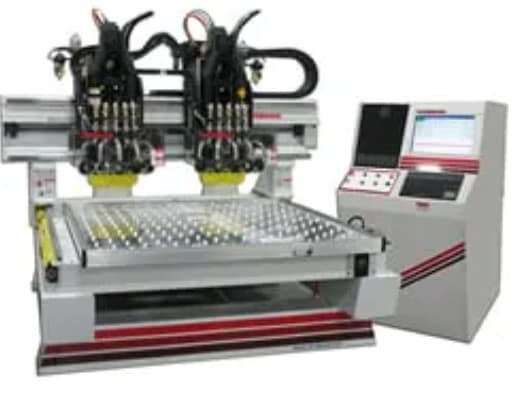
Thermwood is a legendary company within the world of CNC. Their equipment is renowned for being incredibly durable and lasting for decades. The Model 45 represents this philosophy perfectly, providing a robust and versatile 5-axis machine that’s perfect for high production environments that focus on trimming, patterns, and molds. This American-made machine is perfect for those who need a reliable, no-nonsense machine that will get the job done.
Key Features & Specifications
The Thermwood Model 45 is a moving gantry style machine that features a heavy, welded steel frame that’s built for maximum rigidity. This is not just a router – it’s an industrial machine built for continuous duty operation.
Structure: The machine features a fixed table and a moving gantry, providing stability for large and heavy parts. The machine is stress-relieved, heat-treated, and machined for maximum accuracy.
Controller: The Q-Core SuperControl from Thermwood is a feature-rich, PC-based controller that simplifies complicated processes. The controller features advanced functions, such as tool center point programming, as well as impact-resistant heads that can save a program from being ruined after a minor collision.
Spindle: A 12 HP HSD spindle is standard, with options for more power. This spindle is liquid-cooled for continuous operation without overheating.
Accuracy: High-precision ball screws are used in all axes. The machine is laser calibrated for accuracy. Thermwood also offers volumetric compensation as an option. This allows for compensation of all of the geometric imperfections in the machine for near perfect accuracy.
What Makes It Stand Out?
What really sets the Thermwood Model 45 apart is its strength and intelligent control system. The Q-Core SuperControl is not just a motion controller; it is a productivity enhancer. Its capability for automatic handling of Tool Center Point and complex spatial math makes programming easier for the operator. Another advantage of this machine is that Thermwood builds “tank-like” machines. These routers are often used in factories and are running 10-20 years after their initial implementation. This is a testament to their strength and quality of build. The impact-resistant head is another advantage of this machine. This allows for a minor crash without having to realign the machine, saving time and money in the process.
Pros and Cons
Pros:
Exceptional Durability: This machine is built for a 24/7 environment.
Advanced and User-Friendly Controller: The Q-Core SuperControl makes complex 5-axis operations easy for the operator and has several other unique and valuable features.
Great US-Based Support: Thermwood is known for their support team.
High Level of Accuracy: The machine is laser calibrated for accuracy and has volumetric compensation as an option for very tight tolerances.
Cons:
Proprietary Control: The power of the Q-Core controller means you’re locked into the Thermwood system. It is not a standard Fanuc or Siemens controller that many machinists are familiar with.
Heavier Focus on Trimming: Although it has the ability to machine block material, it has been designed and configured for trimming, drilling, and light surfacing operations.
Ideal Use Cases
The Thermwood Model 45 is great for applications that require precise trimming and patterning on large parts.
Aerospace and Automotive Trim: The machine excels for trimming vacuum-formed plastics, carbon fiber components, and fiberglass panels with high accuracy and reliability.
Pattern Making: It is great for creating large-scale master patterns and plugs for foundry and composites industries.
Marine Applications: The machine can be used for machining custom boat hulls, decks, and interior components that demand complex cuts along different axes.
General Plastics Fabrication: The machine is robust and accurate and therefore suitable for high-volume production of plastic components.
4. Haas UMC-1000
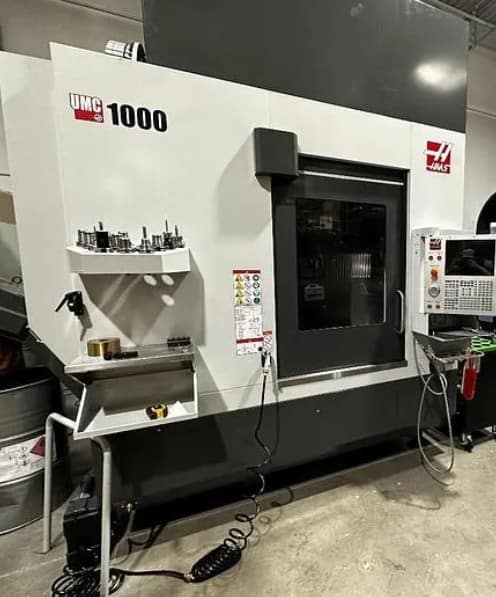
While not exactly fitting the definition of a router, the Haas UMC-1000 should be included on this list as it represents the crossover point for shops that need to machine harder tooling materials like aluminum and steel, as well as composites. The Haas UMC-1000 is an American-made 5-axis universal machining center.
Key Features and Specifications
The Haas UMC-1000 has a rigid C-Frame Cast Iron Column that offers significantly more vibration dampening than gantry-style routers. The machine has an integrated dual-axis trunnion table that represents the heart of its 5-axis machining capabilities.
Work Envelope: The machine has a generous travel range of 40″ x 25″ x 25″ (1016 x 635 x 635 mm). While smaller than the large gantry-style routers on this list, it is massive for a trunnion-style machine at this price point.
Spindle: It comes with a standard inline direct drive spindle that spins at either 8,100 or 12,000 RPM. This gives you a lot of torque as well as thermal stability. This means you can remove a lot of material as you cut through the object.
Trunnion Table: The B and C axes are incorporated directly into the table. This gives you a lot of rigidity that enables you to accurately position objects that weigh as much as 1,000 lbs. This means you can perform 5-axis machining as well as 3+2 machining.
Wireless Probing: This comes as a standard feature with many UMC-1000 machines. The Wireless Intuitive Probing System (WIPS) enables you to perform work offsets with ease.
What Makes It Stand Out?
The Haas UMC-1000 stands out as one of the best 5-axis CNC routing machines available today. While other 5-axis CNC routing machines are limited to machining only plastic and other non-ferrous materials, the UMC-1000 has no such limitations. In other words, it will cut through steel as if it were butter. If you have a shop that requires you to make a lot of complex aluminum aerospace brackets, as well as hard plastic manifolds and steel fixtures, you will find that a 5-axis CNC routing machine will come in handy. The Haas UMC-1000 will make quick work of these jobs. Another factor that makes this machine stand out from the rest is that anyone familiar with a CNC machine will know how to use a Haas UMC-1000. Haas controls are industry-standard.
Pros and Cons
Pros:
True Multi-Material Capability: This 5-axis CNC routing machine has no issues with cutting through steel, aluminum, or titanium.
User-Friendly Control: The Haas Next Generation Control (NGC) has been recognized as one of the easiest controls to use with a CNC machine.
Rigidity: Cast Iron construction provides better surface finishes for hard materials than steel frame routers.
Integrated Trunnion: This feature eliminates the need for bolt-on rotary tables, providing higher accuracy and clearance.
Cons:
Smaller Work Area: Compared to the 5×10 or 5×12 foot router table, the UMC-1000’s working envelope is restrictive. It cannot machine large sheets of material or long aerospace stringers.
Slower Rapids: Although fast for a mill, the UMC-1000’s rapid traverse rates are generally slower than high-speed routers designed for wood and foam cutting.
Chip Evacuation: Unlike other routers, the UMC-1000 uses flood coolant and augers. Machining dry materials like wood or foam can be messy, requiring specific setup to prevent clogging the coolant system.
Ideal Use Cases
The Haas UMC-1000 is the ultimate ‘Router Alternative’ for companies who need the flexibility of working with many different types of materials, but don’t need the capability of working with large parts.
Aerospace Components: Machining complex aluminum brackets, valve bodies, and structural components requiring 5-axis access.
Automotive and Machining: metal prototypes for suspension components, engine components, etc., where the router lacks the necessary rigidity.
Medical Device Manufacturing: Machining precise, complex surgical tools, orthopedic devices, stainless steel, titanium, etc.
Job Shops: A shop that never knows what type of material will walk through the door next, the UMC-1000 is the ultimate safety net.
5. SCM Materia CL
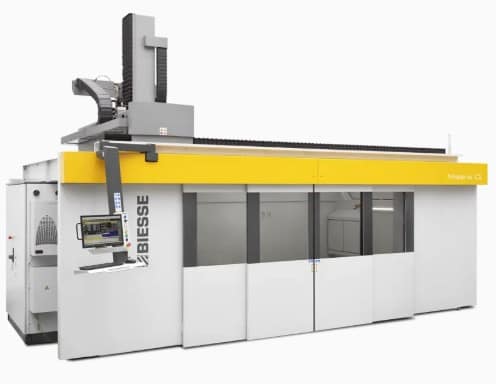
However, when the application calls for large part capability coupled with complex, high-precision machining, the SCM Materia CL is certainly an impressive solution. The SCM Group, another Italian manufacturing giant, developed the Materia CL machine for demanding applications in the aerospace, automotive pattern making, and marine industries. It is a high-gantry machine designed for speed, precision, and the ability to machine large workpieces.
Key Features & Specifications
The Materia CL machine is defined by its high-gantry construction, which offers an extremely large open work area below the machine. This enables the machining of extremely tall, bulky workpieces that are impossible with standard flat-table or even moving gantry machines.
Structure: The machine is built upon a monobloc steel base with high-gantry construction. This construction type offers maximum Z-axis height clearance, making it easy to load large molds and fixtures from all sides.
Work Envelope: The Materia CL machine offers an extremely large work envelope with a potential Z-axis stroke exceeding 1,300 mm (over 51 inches). This massive height is critical for mold making or trimming large three-dimensional workpieces.
Operating Head: The machine is supplied with an extremely powerful direct-drive 5-axis head. The SCM Group offers various high-torque electrospindles, making the machine suitable for machining all materials, including lightweight materials such as foam or composites, as well as denser tooling board or aluminum.
Controller: The machine is usually supplied with an extremely powerful controller such as the Siemens Sinumerik or the OSAI Open. Both are highly regarded for their advanced 5-axis continuous motion control coupled with high-speed data processing.
What Makes It Stand Out?
The first and foremost advantage of the SCM Materia CL is the unparalleled Z clearance. The machine is designed to accommodate large Z clearances, whereas the other machines are limited by the table or the lower gantry. The machine is therefore ideal for making full-scale automotive clay models, large boat hulls, and deep molds required in the aerospace industry. The machine has a very large workspace, and the operator has access to the workspace, making it easier to load the part. The machine is therefore unique due to the combination of the large Z clearance and the 5-axis head.
Pros and Cons
Pros:
Exceptional Z-Axis Clearance – Enables machining of very tall parts that are out of reach for most other routers.
High-Performance Machining – Direct drive head and powerful spindle provide exceptional accuracy and finish, even when cutting aggressively.
Open and Accessible Design – Facilitates easy loading and unloading of large, heavy workpieces.
Versatile Material Capability – Capable of being configured to effectively cut a wide variety of materials, from foam to aluminum.
Cons:
Large Footprint – High-gantry design requires a lot of vertical and horizontal floor space in the shop.
Premium Price Point – A high-end industrial-grade machine, and priced as such due to its specialized capabilities and overall size.
Requires a Solid Foundation – Due to its size, as well as dynamic forces that must be accounted for during operation, a very stable and thick foundation of concrete is required for installation.
Ideal Use Cases
The SCM Materia CL is a go-to machine for industries that work big and need precision.
Automotive Design Studios – Perfect for milling full-size clay models and design prototypes where scale and finish are critical.
Marine Industry – Ideal for creating plugs and master molds for boat hulls, decks, and other large fiberglass parts.
Aerospace Pattern Making – Machining large-scale patterns and molds for composite layups, such as tooling for wing sections or fuselage panels.
Amusement Park and Theming – Machining large, complex props and architectural features for theme parks and exhibits.
6. Anderson Stratos Pro
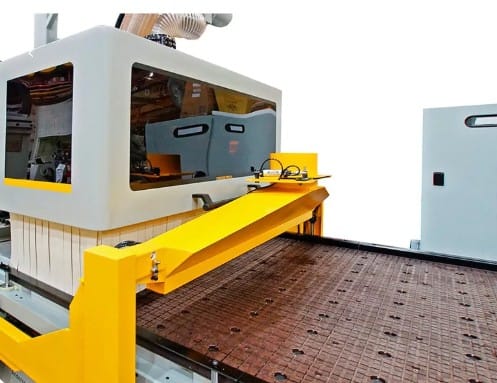
For a manufacturer looking for a heavy-duty, high-speed solution for cutting non-ferrous metals and exotic composites, the Anderson Stratos Pro is a top-of-the-line contender. Anderson Group is a world leader in CNC technology, and they developed the Stratos Pro to fill the gap between high-speed wood routing and rigid metal cutting mills. It has the flexibility required for high-speed material removal and the rigidity required for top-notch surface finish.
Key Features & Specifications
The machine is based on a Moving Bridge configuration, which is inherently more rigid than a Moving Gantry machine since the bridge supports are bolted to the base. It is a more stable platform from which to perform high-precision machining.
Structure: The machine has a monolithic steel base and a Moving Bridge configuration. The Moving Bridge is a heavily ribbed and thermally stress-relieved machine structure, which is required to maintain its geometric accuracy over long periods of operation.
Spindle Technology: Anderson is renowned for their proprietary spindle technology. The machine is usually equipped with a liquid-cooled, high-torque spindle (up to 22kW/30HP) and a top speed of 24,000 RPM. The torque and speed are critical to cutting aluminum and dense tooling boards quickly and efficiently.
Linear Drive System: One of the machine’s premium features is the linear motor drive system, which is used in the X and Y axes. The linear motor drive system is a unique option since the machine is usually equipped with a traditional ball screw and rack and pinion system. The linear motor drive system is a frictionless drive system, resulting in very high acceleration rates and zero backlash.
Controller: The machine is usually paired with a Fanuc 31i-B5 controller, which is the gold standard in the CNC world and is recognized for its reliability and ability to perform look-ahead processing.
What Makes It Stand Out?
The Anderson Stratos Pro differentiates itself through its performance. The ability to use linear motor drives differentiates it from all other competitors in the router class. The linear motor drive allows for rapid acceleration and deceleration through sharp corners without sacrificing precision. It is intended for use with “high speed machining” (HSM) techniques. These techniques use light cuts made at extremely high speeds to prevent heat buildup and tool deflection.
Pros and Cons
Pros:
– Extreme Speed and Agility: The linear motor technology has the ability for extremely high acceleration and feed rates.
– Better Rigidity: The moving bridge design gives it superior stiffness, which translates into better finishes on harder metals like aluminum.
– Fanuc Control: The Fanuc control system is the industry standard and offers superior reliability and availability for operators.
– Better Chip Management: The machine design allows for superior chip management through the use of chip conveyor systems and enclosures.
Cons:
– Expensive: The cost of entry for this machine is significantly higher than for other routers on the market.
– Complex Maintenance: The linear motor drive requires specialized knowledge for maintenance and repair.
– Power Consumption: The machine has high power requirements.
Ideal Use Cases
The Anderson Stratos Pro has been designed for industries that require speed and precision. It has been designed for use with non-ferrous metals.
Aerospace Aluminum Components: The Anderson Stratos Pro has the ability for high speed machining of aluminum components for use in aerospace applications.
Automotive Mold Making: Excellent for rapid roughing and finishing of aluminum molds used in injection molding or thermoforming.
Composite Trimming: Due to its high-speed and rigidity characteristics, it is ideal for trimming of stiff composite parts that require sharp edges.
Sign Making and Facades: Trimming of stiff aluminum or composite facade panels used in architectural applications where finish quality is visible and important.
7. CMS Ares
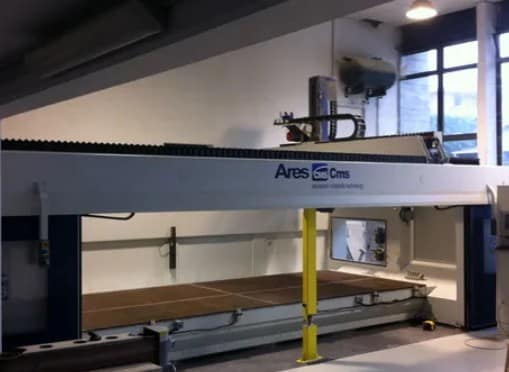
CMS Industries is a giant in the world of large-scale CNC machining centers. The Ares series of machines from this company is a true reflection of their engineering capabilities. This series of machines is specifically designed for high-speed trimming and milling of composites, aluminum, and light alloys. This machine is a true marvel of engineering that combines massive scale with incredible precision. This machine is particularly popular in the aerospace, marine, and automotive racing industries, where large parts of lightweight materials are the norm.
Key Features & Specifications
The CMS Ares is a moving bridge type of CNC machining center that is known for its structural integrity and dynamic movement within a large working envelope. This machine has been specifically designed for high-speed trimming and milling of composite materials, aluminum, and other light alloys. This machine is particularly popular in the aerospace, marine, and automotive racing industries. This machine combines massive scale with incredible precision and accuracy. This machine has been specifically designed for trimming and milling of composites, aluminum, and other light alloys. This machine has been specifically designed for trimming and milling of composite materials, aluminum, and other light alloys. This machine has been specifically designed for trimming and milling of composite materials, aluminum, and other light alloys. This machine has been specifically designed for trimming and milling of composite materials, aluminum, and other light alloys.
This machine has been specifically designed for trimming and milling of composite materials, aluminum, and other light alloys. This machine has been specifically designed for trimming and milling of composite materials, aluminum, and other light alloys. This machine has been specifically designed for trimming and milling of composite materials, aluminum, and other light alloys. This machine has been specifically designed for trimming and milling of composite materials, aluminum, and other light alloys. This machine has been specifically designed for trimming and milling of composite materials, aluminum, and other light alloys. This machine has been specifically designed for trimming and milling of composite materials, aluminum, and other light alloys.
Dust and Debris Management: The machine stands out with its superior dust management system. The dust collection hood provided with the machine’s operating head encapsulates the cutting tool. This is important to contain composite dust, such as carbon fiber.
Controller: The machine is usually controlled by high-end Fanuc or Siemens controllers. These are robust controllers known for their high-performance capabilities during simultaneous machining in five axes.
What Makes It Stand Out?
The most important aspect that makes the CMS Ares stand out is its ability to perform high-speed finishing machining. Although several machining centers are capable of machining composites, the Ares is designed specifically for the task.
The combination of the machine’s lightweight yet robust head, its dual-drive gantry system, and its superior dust management system makes the machine the best choice for trimming or drilling composite parts such as carbon fiber or fiberglass. The machine maintains its high accuracy even at high feed rates.
Pros and Cons
Pros:
Optimized for Composites: The machine is best suited for machining composites owing to its superior dust management system. The machine is also designed for high-speed machining.
High Dynamic Accuracy: The dual-drive system makes the machine highly accurate even during high-speed machining.
Large, Accessible Work Area: The machine is provided with a large work area due to its moving bridge design. The work area is large and open.
Industry Standard Controller: The machine is provided with Fanuc or Siemens controllers.
Cons:
Not for Heavy Roughing: It is designed to be a high-speed finishing machine. It should not be used for heavy material removal from large blocks of metal.
Premium Investment: It is a specialized machine made by a top-tier company and therefore carries a premium price tag with it.
Requires Skilled Programming: It requires well-optimized CAM programs to take advantage of its high-speed capabilities.
Ideal Use Cases
The CMS Ares is most at home in an environment where speed and precision on large, lightweight materials are of prime concern.
Aerospace Industry: Trimming and drilling carbon fiber reinforced polymer components such as sections of an aircraft fuselage, aircraft winglets, and aircraft interior components.
Automotive/Motorsport Industry: Trimming and drilling composite chassis components, composite aerodynamic body components, etc.
Marine Manufacturing Industry: Trimming and drilling large fiberglass boat hulls and deck components.
Advanced Materials Industry: Machining complex prototypes made out of different composites and light alloys.
8. C.R. Onsrud 5-Axis Pro Series
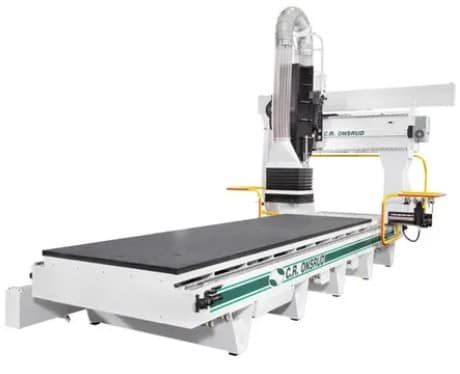
In the world of North American manufacturing, “heavy iron” and “C.R. Onsrud” are synonymous. While some manufacturers are focused on building machines for lightweight speed, Onsrud takes an approach to building machines with an “over-engineering” philosophy. Their 5-Axis Pro Series is the culmination of this approach, offering a massive machine with capabilities for heavy material removal rates that would make many other machines shudder. It is their favorite machine for shops that will not compromise on build quality.
Key Features and Specifications
The Pro Series is a moving gantry style CNC router designed for high-performance machining of large, complex parts. It is designed to be used 24/7 in the most demanding environments.
Structure: The core of the Pro Series is the massive, thick-walled structural steel frame. Unlike other machines, which are made up of extrusions bolted together, the Pro Series frame is welded, stress-relieved, and machined as one piece. This provides the machine tool with outstanding dampening characteristics.
Spindle Power: C.R. Onsrud machines are generally equipped with high-torque, liquid-cooled spindles ranging from 12 HP up to over 20 HP. This allows for the heavy load capacity, which not only makes the machine suitable for wood and foam, but also for large-scale aluminum cutting.
Dual Table Configuration: Many of the Pro Series machines are designed as a dual-table machine. This allows the user to load the part onto one table while the machine is cutting the other. This maximizes the time spent cutting, thereby increasing the machine’s overall throughput.
Controller: C.R. Onsrud machines generally use either the Fanuc or Osai controller. The Fanuc 31i-B5, commonly used in the Pro Series, is an industrial-strength machine capable of high-speed processing for smooth 5-axis operation.
What Makes It Stand Out?
The Pro Series stands out by virtue of its overall rigidity and torque. Many 5-axis router machines are, in effect, trimming machines, designed for cutting the edges of formed parts. This is not the case for the C.R. Onsrud Pro Series. This is not a trimming machine; it is a machining center. It has the mass, the torque, and the capability to cut through solid blocks of wood, tooling board, or even aluminum plates as if it were a vertical mill, but with the large working envelope of a router.
Pros and Cons
Pros:
Tank-Like Construction: This machine has a steel frame, which helps in absorbing vibrations and thus provides a smoother finish and longer tool life.
High Material Removal Rates: It can remove more material and make deeper cuts in hard materials compared to a standard router.
Continuous Operation: This machine, with its dual table option, ensures that there are no stoppages for loading and unloading.
Top-Tier Support: C.R. Onsrud has a reputation for providing exceptional customer support and services in the US.
Cons:
Heavy Floor Load: This machine, because of its weight, requires a thick foundation that has to be made of concrete.
Cost: This machine, with its “overbuilt” construction, also comes with a hefty price tag, which places it firmly in the premium segment.
Physical Footprint: This machine, with its large safety enclosure and massive gantry, also requires a large footprint in the workshop.
Ideal Use Cases
The C.R. Onsrud Pro Series is the machine of choice for shops that require a router that can function like a mill.
Heavy Aerospace Components: Machining large structural aluminum parts, ribs, and bulkheads where rigidity is a requirement.
High-End Furniture: Machining large, intricate, and heavy wood furniture components that require hogging out a lot of material.
Large-Scale Mold Making: Machining large foundry patterns and composite molds from dense tooling board.
Thermoforming and Rotomolding: Trimming thick-gauge plastic parts where rigidity ensures that there are no chatter marks on the cut edge.
9. HOMAG CENTATEQ P-210
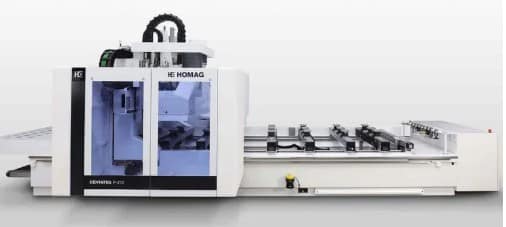
HOMAG, a part of the HOMAG Group based in Germany, is a global industry leader in providing integrated solutions for the woodworking industry.
Their CENTATEQ P-210 is a prime example of German engineering and is a compact, versatile, and extremely accurate 5-axis machine designed for small to medium-sized workshops requiring advanced technology without a large footprint. It is the machine of choice for custom furniture makers, stair builders, and architectural millwork companies.
Key Features and Specifications
The CENTATEQ P-210 is a gantry machine that uses a console table (pod and rail) system, which is ideal for working on solid wood parts and complex joinery projects.
Structure: The CENTATEQ P-210 has a sturdy gantry construction with a substantial base for minimal vibration during operation. The gantry glides smoothly over accurate linear guides for precise movement across the work area.
Operating Head: The operating head is the heart of the machine and consists of a 5-axis head called the DRIVE5CS. This is a powerful and compact operating head, usually supplied with a 10 kW or 12 kW liquid-cooled spindle for solid wood and panel work and light aluminum applications.
Console Table (Pod and Rail): The pod and rail table system is ideal for workpiece accessibility from all angles.
This is an ideal system for edge banding, horizontal drilling, and other applications where the cutter needs to access the side of the workpiece. The consoles and vacuum pods are often auto-positioning for fast and efficient setup.
Controller and Software: The machine is controlled by HOMAG’s powerControl and woodWOP software interface. The woodWOP is a programming system for the workshop environment and is extremely easy to use for programming complex 3-D shapes and 5-axis cuts through a graphical interface.
What Makes It Stand Out?
Staircase Construction: Perfectly suited for machining intricate handrails, volutes, and custom stringers that require compound angles.
Custom Door and Window Manufacturing: Allows for the creation of arched windows, custom entry doors, and intricate mullions in a single setup.
Architectural Millwork: Ideal for creating unique one-off decorative items and fixtures that require multi-axis machining.
10. AXYZ Trident Series (5-Axis Configuration)
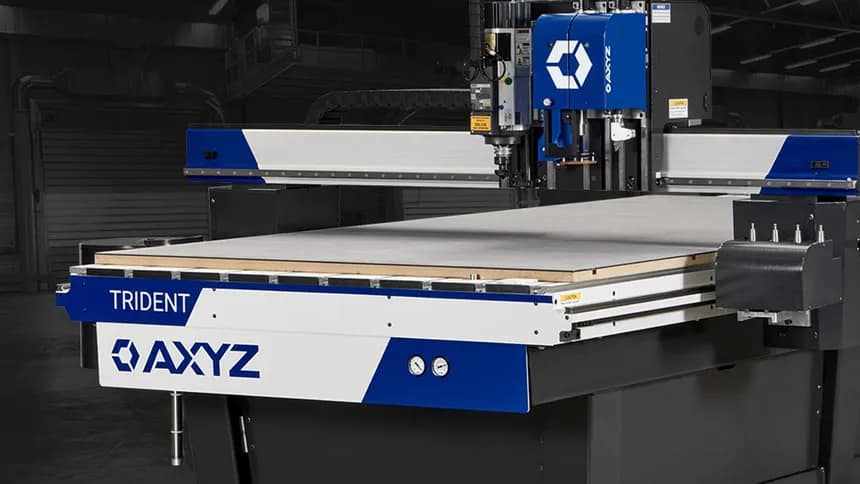
For small shops that require versatility without the daunting price tag that comes with a heavy industrial iron, the AXYZ Trident Series may represent a viable option. While AXYZ machines are often associated with sign shops and smaller operations, their 5-axis configurations, often featuring the HSD 5-Axis head, make multi-axis machining accessible to small-to-medium businesses. It’s a machine that’s been engineered with ease of use, accessibility, and a wide range of materials from foam to soft metal.
Key Features and Specifications
The Trident Series is a modular-style machine that can be heavily customized to meet specific shop requirements. While not as robust as a C.R. Onsrud or a Thermwood, it’s a solid platform nonetheless.
Structure: Welded steel frame with a gantry-style configuration. The Trident Series has a proprietary helical rack & pinion drive system that produces smoother motion with higher acceleration than conventional gear drive systems. This means reduced vibration as the tool changes direction.
Spindle: Typically comes with an HSD 5-Axis spindle system that’s often found in the 10HP-12HP range. While this will suffice for cutting wood, plastics, and aluminum cladding materials, it will not have enough power for hogging solid aluminum blocks.
Smart Console: The equipment is operated through the AXYZ A2MC controller, which is user-friendly and has a simple interface that makes file management and operating the equipment easy and efficient. Some of the features include “Live Deck,” which enables the user to adjust the feed rate and spindle speed in real time.
Tool Changing: The equipment is also fitted with an automatic tool changer, which enables the equipment to operate continuously without the need to change the cutting tool.
What Makes It Stand Out?
The most outstanding feature of the AXYZ Trident is its modularity and flexibility. You can adjust the bed to almost any desired length, ranging from the standard 4′ x 8′ to as large as 50 feet. This is the most flexible equipment, especially considering the unique needs that come with unusual business environments and the need to cut long materials such as boat spars and architectural beams. Moreover, the price is lower compared to the heavy industrial equipment presented in this list, making 5-axis technology accessible to small businesses, schools, and prototyping environments.
Pros and Cons
Pros:
Cost-Effective Entry: The equipment is one of the most affordable 5-axis machines available.
Highly Customizable: The equipment is highly customizable, allowing the user to adjust the width and length of the cutting bed to meet specific needs.
User-Friendly Interface: The equipment is easy to operate, even for a beginner, as the A2MC controller is easy to comprehend, especially when compared to the complex Siemens and Fanuc systems.
Ideal for Working with Sheets: The equipment is highly efficient in cutting large sheets of plastic and wood, thanks to the excellent vacuum hold-downs.
Cons:
Lighter Duty: The frame and gantry are not designed for cutting loads like an Onsrud or a DMS. This machine is more appropriate for trimming and light milling.
Z-Axis Limitations: The Z-axis travel is somewhat more constrained than a dedicated mold-making machine.
Vibration in Hard Materials: While it can be used to machine aluminum, it might be more prone to vibration or require slower feed rates than some of the heavier cast iron or heavy steel machines.
Ideal Use Cases
The AXYZ Trident is the perfect “first” machine in a 5-axis CNC environment or a dedicated machine for working with lighter materials.
Sign Making & 3D Lettering: Creating complex, three-dimensional signs out of foam, acrylic, or wood.
Educational Institutions: Ideal for university architecture or engineering programs where ease of use is a high priority.
Thermoforming Trimming: Trimming vacuum-formed plastic parts for packaging, automotive, or point of sale displays.
Scenography and Props: Cutting foam and soft woods for theater, movie props, and trade show displays.
Conclusion 10 Best 5 Axis CNC Router Machines for 2026
Finding the right 5-axis CNC router is about more than just comparing the specs of each machine. It’s about finding the strategic partner that fits your specific needs. As we’ve seen in our in-depth look at the different machines, the “best” machine is completely relative to the needs of the operation. A high-speed trimmer like the CMS Ares would be out of place in a shop working with heavy furniture, just as a woodworking machine like the HOMAG would be out of place in a shop working with aluminum parts for the aerospace industry.
From the industrial powerhouses like C.R. Onsrud and Thermwood that are designed for a lifetime of hard work removing material, to the versatile crossover machines like the Haas UMC-1000 that combine milling and routing capabilities in one machine, there are many specialized machines in this space. Whether you require the incredible Z-axis access of the SCM Materia CL for mold work, or the modularity of the AXYZ Trident for lighter prototyping work, there is a machine that has been engineered specifically for your exact needs.
But before you make your final choice, be sure you evaluate your priorities carefully. Will you be looking for a machine that meets your needs today, but also has the potential for growth in the future? Will you be working with a variety of different materials that require different capabilities? Will you be relying on a machine that is easy for your operators to use? Buying a 5-axis machine is not just about what you need today; it’s about what you’ll need in the future. And remember that buying a 5-axis machine is not a limitation; in fact, it’s often the opposite. By giving you access to capabilities that 3-axis machines simply do not have, you are opening doors that would otherwise remain closed.
Ready to take your manufacturing capabilities to the next level with one of the 10 Best 5 Axis CNC Router Machines for 2026? Don’t let all of these technical specifications scare you off. We encourage you to take the time you need to request demos of these machines in your shop, speak with other owners of these machines, and run your own parts on these machines. And if you are still unsure of what direction you should be going in, there are experts in this field that would be happy to speak with you about what machine would be best for your shop. The right 5-axis router is out there waiting for you.